
Affiliate Disclosure: This post may contain affiliate links. If you purchase through these links, I may earn a small commission at no extra cost to you. I only recommend products I genuinely find helpful for families.
These science activities for preschoolers are simple, fun, and designed to spark curiosity.
In this post:
- easy experiments you can do at home
- safe, kid-friendly setups
- ideas that actually hold attention
Science for preschoolers isn’t about memorizing facts or sitting through lectures. It’s about letting children explore the world around them through touch, observation, and play. When a three-year-old drops a rock into a puddle and watches the splash, they’re doing science. When a four-year-old mixes red and blue paint and gasps at the purple result, they’re experimenting with basic science concepts.
The activities in this guide are designed for children ages 3–5 and use common household items you likely already have: baking soda, white vinegar, food coloring, plastic cups, and recycled materials. As of 2026, these simple ingredients remain the gold standard for preschool science because they’re safe, inexpensive, and produce dramatic results that spark curiosity in young learners.
Why invest time in preschool science activities? The benefits extend far beyond future learning in STEM subjects. Science play builds observation skills, encourages critical thinking, expands vocabulary, and helps children understand cause-and-effect relationships. It also gives kids confidence—the belief that they can figure things out and that their questions matter.
This article dives straight into ready-to-use activity ideas organized by science domain. After the experiments, you’ll find practical guidance on safety, setup tips, how to talk science with young children, and ways to involve families in the fun.
Quick overview of what’s ahead:
- Why science matters in early childhood development
- Core science concepts preschoolers can explore
- Hands-on experiments in physics, chemistry, biology, weather, and engineering
- Safety and setup tips for home or classroom
- Communication strategies to deepen learning
- Ideas for sharing science with families
Why Science Matters in Early Childhood
When children pour water through a funnel or watch ice melt in warm water, they’re building the foundation for scientific thinking that will serve them for years. Research shows that early exposure to science experiments fosters positive attitudes toward STEM and improves problem solving abilities throughout life. Preschool science isn’t about creating mini-scientists—it’s about nurturing the curiosity children already have.
Simple experiments help children practice essential skills in age-appropriate ways. They observe what happens when they mix two ingredients. They predict whether an egg sinks or floats before testing it. They compare how fast toy cars roll down different surfaces. And they explain their discoveries using their own words, building vocabulary with terms like “melt,” “dissolve,” and “magnetic.”
Consider a 2026 bath time scene: a child drops various objects into the tub—a rubber duck, a plastic spoon, a small rock—and watches some float while others sink. Without formal instruction, they’re conducting a simple science experiment about buoyancy. They’re making predictions, testing them, and revising their understanding based on results.
Science activities support multiple developmental areas simultaneously:
- Cognitive skills: Observation, prediction, comparison, and reasoning
- Fine motor skills: Using droppers, pouring liquids, manipulating small objects
- Social-emotional skills: Taking turns, sharing tools, handling the frustration of unexpected results
- Language development: Learning new vocabulary and explaining discoveries
The takeaway is straightforward: curiosity now builds science confidence later.

Core Science Ideas for Preschoolers to Explore
The activities throughout this guide focus on a handful of big ideas that preschoolers can begin to understand: physics, chemistry, biology, Earth science, and simple engineering. These aren’t abstract theories—they’re concepts children encounter every day without realizing it.
Here are the specific concepts we’ll revisit across different activities:
- Sink and float (buoyancy): Why does the rubber duck stay on top of the water while the rock goes down? Children test various objects to discover patterns.
- Melting and freezing: Ice cubes shrinking in a cup at lunch, frozen water bottles becoming liquid—kids notice temperature changes constantly.
- Plant growth and living things: Seeds sprouting in a garden, caterpillars becoming butterflies, understanding what needs food and water to survive.
- Weather and the water cycle: Puddles disappearing on a sunny day, rain falling from clouds, fog on a cold morning window.
- Magnetism: Magnets on the fridge holding artwork, magnetic toys clicking together, metal paper clips jumping to a magnet wand.
- Surface tension and chemical reactions: Soap bubbles holding their shape, fizzing when vinegar meets baking soda, colors swirling in milk.
- Simple machines and engineering: Ramps making it easier to roll balls, pulleys lifting toys, building towers that balance or topple.
The activities in later sections are organized to revisit these concepts often, building familiarity over time through repetition with different materials.
Simple, Hands-On Science Activities for Preschoolers
This is the main grab-and-go section with concrete hands on experiments that use simple materials you already have. Each activity takes under 20–30 minutes and works well for small groups or one-on-one play. The experiments are organized by science domain so you can easily find what fits your theme or your child’s current interests.
Easy Physics: Sink-or-Float, Ramps, and Dancing Objects
Physics activities let children explore forces, motion, and how objects behave in water and air. These classic experiments produce visible, repeatable results that preschoolers find endlessly fascinating.
- Sink or Float Tub Test: Fill a plastic bin with room temperature water. Gather various objects: a metal spoon, crayon, plastic block, apple, cork, coin, and small toy. Before each object goes in, ask the child to predict whether it will sink or float. Let them test, observe, and sort items into two groups. This experiment demonstrates buoyancy and encourages prediction skills. Safety note: Supervise constantly around water; remove small items that could be choking hazards.
- Ramp and Friction Challenge: Tape cardboard ramps to a chair at an angle. Cover sections with different materials—aluminum foil, sandpaper, a towel, and bare cardboard. Have children roll toy cars down each surface and compare speeds. Which surface makes the car go fastest? Slowest? This introduces friction as a force that slows things down. Kids can test different surfaces and record results with simple drawings.
- Dancing Raisins or Corn: Fill a clear jar or empty glass with carbonated water or clear soda. Drop in a few raisins or dried corn kernels. Watch as they sink, then rise as gas bubbles attach, then sink again when bubbles pop off. This creates a mesmerizing “dance” that introduces concepts of gas, density, and buoyancy. Safety note: This is for observation only—no tasting the soda afterward.
Colorful Chemistry: Baking Soda, Vinegar, and Magic Milk
Chemistry activities are where the drama happens. Fizzing, bubbling, and color swirling create memorable moments that children want to repeat again and again. These easy science experiments use safe, common household items.
- Rainbow Volcano Tray: Place a muffin tin or several small cups on a tray. Add a spoonful of baking soda to each cup. Put a few drops of different food coloring in each (red, blue, yellow, green). Give children droppers filled with white vinegar and let them squeeze vinegar into each cup. Watch colorful fizzy eruptions! This classic experiment demonstrates a simple acid-base reaction. The visual drama of bubbling colors makes it a fantastic way to introduce chemical reactions.
- Magic Milk Experiment: Pour whole milk into a shallow dish until it covers the bottom. Add drops of food coloring in different spots—don’t stir. Dip a cotton swab in dish soap (dishwashing liquid works perfectly). Touch the milk with the soapy swab and watch the colors explode and swirl outward. This experiment demonstrates surface tension—the soap breaks the surface tension of the milk, causing the colors to scatter. Use food-safe materials and supervise closely.
- Color-Mixing Fizz: Make colored vinegar by adding food coloring to vinegar in squeeze bottles (red, yellow, blue). Place small piles of baking soda on a tray. Children squeeze different liquids onto the baking soda and observe both the fizzing reaction and the new colors that form when primary colors mix. This combines chemistry with color theory.
Setup tip: Use smocks, place trays under everything, and work on washable surfaces. These activities are ideal for kitchen tables or classroom sensory tables.

Life Science: Plants, Animals, and Living vs. Non-Living
Life science activities help children observe, nurture, and understand living things. These experiments often happen over days or weeks, teaching patience and daily observation alongside biology concepts.
- Growing Beans in a Clear Cup: Wet a paper towel or cotton balls and press them against the inside of a clear plastic cup or clear container. Tuck dry beans (lima beans work well) between the paper towel and the cup wall so they’re visible. Place in a bright window. Over 5–10 days, children watch roots emerge and grow downward while stems reach upward. This introduces plant life cycles and what seeds need to grow.
- Color-Changing Celery or Flowers: Fill cups with water and add different food coloring to each (use a few drops of red, blue, and yellow). Place celery stalks or white carnations in the colored water. Over 24–48 hours, watch as the plants “drink” the colored water and change color. This experiment demonstrates capillary action—how water travels through plants. Children see direct evidence of plants absorbing water.
- Living or Non-Living Sorting Game: Gather a mix of items: real leaves, small rocks, toy animals, toy cars, pictures of pets, a shell, a pencil. Have children sort items into “living” and “non-living” groups. Discuss the criteria: Does it need food? Does it grow? Can it move on its own? This builds classification skills and understanding of what makes something alive.
- Pollination with Pom-Poms: Create simple paper flowers and dust the centers with chalk dust or colored cornmeal as “pollen.” Clip pom-poms to clothespins to make “bees.” Children move their bees from flower to flower, watching the powder transfer. This introduces how pollinators help plants reproduce.
Emphasis: Focus on observation over outcome. Encourage noticing changes each day, drawing what they see, and using simple terms like “grow,” “drink,” and “alive.”
Weather and Water: Rain Clouds, Water Cycle, and Ice
Weather activities connect children to natural phenomena they experience daily. These experiments make invisible processes visible and help kids understand what’s happening outside their window.
- Rain Cloud in a Jar: Fill a clear jar with water. Top it with a thick layer of shaving cream—this is your cloud. Mix water with blue food coloring in a small cup. Use a dropper to slowly add colored water on top of the shaving cream. Watch as the “rain” eventually falls through the cloud into the clear water below. This rain cloud experiment introduces how clouds fill with water and release precipitation.
- Water Cycle in a Bag: Fill a zip-top bag about one-quarter full with water tinted with blue food coloring. Seal it tightly and tape it to a sunny window. Over a day or two, children observe evaporation (water rising), condensation (droplets forming on the bag), and “rain” (drops running down). On a sunny day, this works beautifully and makes the water cycle tangible.
- Melting Race Experiment: Place ice cubes in separate bowls. Sprinkle one with salt, place one in warm water, leave one at room temperature, and wrap one in a paper towel. Have children predict which will melt fastest. Check every few minutes and observe. This introduces how different conditions affect melting—temperature, salt, and insulation all play roles.
These activities work best near a window or outside. Encourage children to draw what they observe or take photos to document changes over time.
Magnets, Light, and Simple Engineering
Engineering and physics activities encourage trial-and-error thinking and the question “What happens if we change this?” These stem activity options build problem solving skills through hands-on tinkering.
- Magnet Hunt: Give children a sturdy magnet wand and a tray of mixed objects: paper clips, plastic buttons, wooden blocks, coins, aluminum foil balls, and keys. Let them test each object and sort into “magnetic” and “not magnetic” piles. This introduces magnetism and the properties of different materials. Children discover that not all shiny things are magnetic.
- Shadow and Light Play: Set up a blank wall or hang a white sheet. Give children a flashlight and simple shapes cut from cardboard. In a slightly darkened room, let them move objects closer and farther from the light source. Watch shadows grow, shrink, and change shape. This introduces how light travels and creates shadows.
- Homemade Pulley Station: Tie a rope over a low beam, sturdy chair back, or playground bar. Attach a small bucket or yogurt container to one end. Children pull the rope to lift lightweight toys. This demonstrates how pulleys make lifting easier—a fundamental simple machine concept.
- Robot Hand (Advanced): For older preschoolers with adult help, create a paper hand with straws taped along “fingers” and yarn threaded through. Pulling the yarn makes the fingers curl. This engineering project introduces how tendons work and builds fine motor skills through careful construction.
Encourage tinkering and asking questions: “What happens if we use a bigger magnet?” “What if we move the flashlight closer?”

Quick Safety & Setup Tips for Preschool Science
Safety and supervision are non-negotiable when doing science with young children. Even simple experiments with baking soda, vinegar, and water require constant adult attention. With proper planning, preschool science activities are safe, manageable, and fun way to learn.
Materials to supervise strictly or avoid:
- No small beads, marbles, or objects under 1.25 inches for children under 3 (choking hazard)
- Keep strong cleaners, hot liquids, and sharp tools completely out of reach
- Prefer food-grade materials: baking soda, flour, food coloring, dish soap, and white vinegar
- Never leave children unattended around water, even shallow amounts
- Avoid activities involving heat sources or electricity without direct adult control
Recommended safety gear and setup:
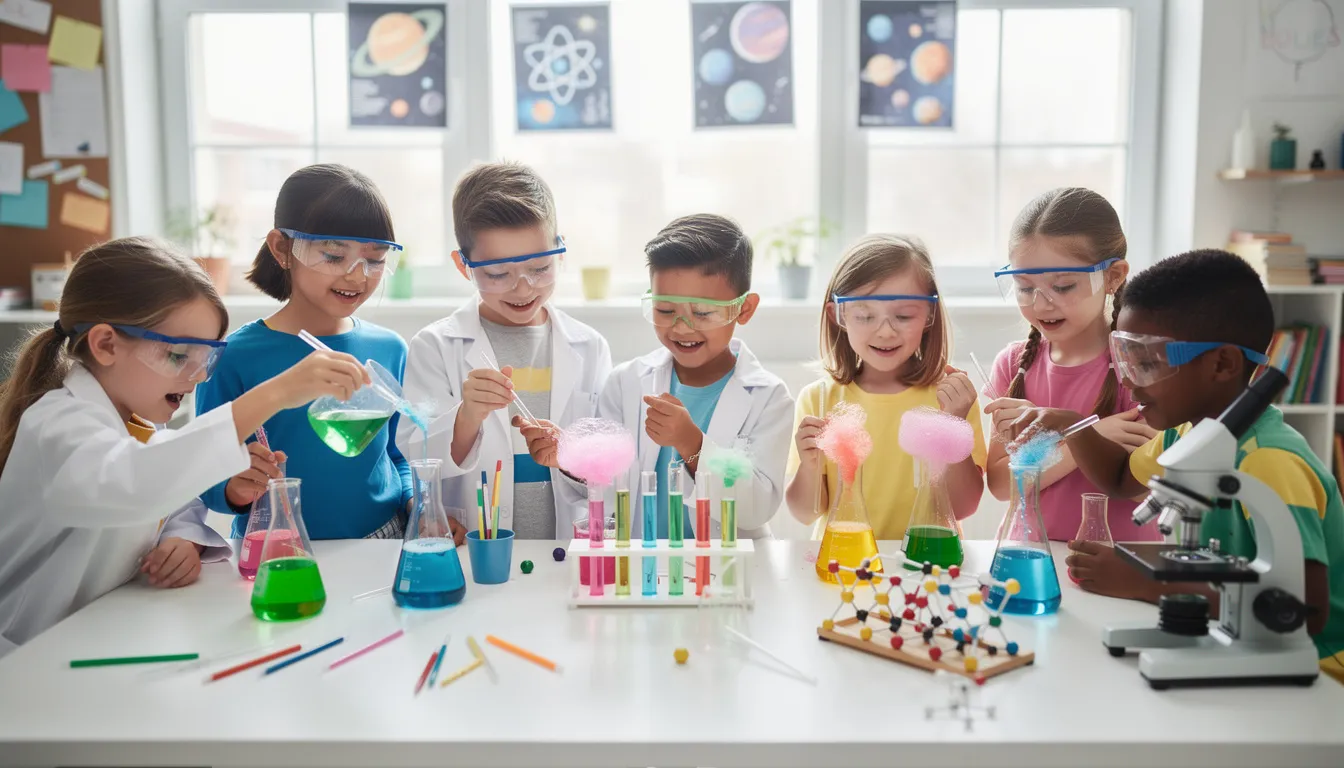
- Use child-sized safety goggles for any experiment requires splashing potential—this also helps kids “feel like scientists”
- Provide smocks or old t-shirts for messy experiments
- Set up designated science areas with washable trays or baking sheets to contain spills
- Keep paper towels or old towels nearby for quick cleanup
- Create clear visual boundaries using a mat or specific table marked as “the science table”
- Work on surfaces that can handle water and stains (not carpeted areas)
With these precautions in place, science experiments become manageable adventures rather than cleanup nightmares. A little preparation makes it possible to explore safely in any home or classroom.
How to Talk Science with Preschoolers
The magic of science activities happens not just in the experiment itself but in the conversations around it. Language and thoughtful questions turn simple play into genuine learning moments that build understanding and vocabulary.
Rather than telling children what will happen, ask questions that encourage them to observe, predict, and explain. This approach develops critical thinking and helps children see themselves as capable investigators.
Open-ended questions to use during any activity:
- “What do you notice?” (encourages observation)
- “What do you think will happen if we add more vinegar?” (encourages prediction)
- “Why do you think the ice melted faster in warm water?” (encourages reasoning)
- “What was different about these two?” (encourages comparison)
- “What should we try next?” (encourages experimentation)
Expanding children’s language:
When a child says “It’s bubbly!”, respond with expansion: “Yes! The vinegar and baking soda made bubbles when they mixed. That’s called a reaction.” This technique validates their observation while introducing new vocabulary naturally.
Simple documentation ideas:
- Invite children to draw what they saw before and after the experiment
- Take photos together and look at them later, asking “What was happening here?”
- Create simple charts with words like “float,” “sink,” “melt,” or “grow” and let children place objects or stickers in the right column
- Use a class journal or observation notebook where adults write down children’s exact words
Documentation helps children revisit experiences and reinforces learning over time.
Sharing Preschool Science with Families
Keeping families informed about classroom science helps them continue the exploration at home. When parents understand what their children are learning, they can reinforce concepts during everyday moments.
Communication ideas that work:
- Send brief weekly summaries or photos of experiments (e.g., “This week we made a rain cloud in a jar on February 5, 2026. Ask your child what happened when the ‘cloud’ got full!”)
- Create simple take-home activity cards with experiments using common household items families already have
- Suggest bath time science: “Try a sink-or-float test with bath toys and plastic cups!”
- Recommend kitchen science: “Watch ice melt in a cup at dinner and guess how long it takes”
- Share observation prompts: “On your walk today, look for shadows and notice how they change”
Tips for effective family communication:
- Avoid technical jargon—focus on what the child did and what they noticed
- Provide translations in families’ home languages when possible
- Include photos showing children actively engaged (not just finished products)
- Suggest specific questions parents can ask: “What color did the celery turn?” or “Which car went fastest down the ramp?”
When families understand that science happens through everyday curiosity—not expensive kits or special knowledge—they’re more likely to create science moments at home.
Bringing It All Together: Making Science Part of Every Week
Preschool science works best when it becomes a regular rhythm rather than an occasional special event. Consider building one focused experiment into each week while weaving observation moments throughout daily activities. Snack time becomes a chance to notice how butter melts on warm toast. Outdoor play becomes an opportunity to observe shadows, wind, and insects.
The experiments in this guide range from quick, high-impact activities (like baking soda and vinegar eruptions that take 10 minutes) to longer-term observations (like watching beans sprout over two weeks or tracking the water cycle in a bag taped to a window). Mixing both types keeps children engaged while teaching different skills—some science concepts reveal themselves in seconds, while others require patience and daily attention.
You don’t need a lab, expensive equipment, or a science degree to introduce young children to scientific thinking. A few jars, basic pantry items like baking soda and dish soap, recycled materials from your kitchen, and genuine curiosity are enough to create meaningful science experiences. The goal isn’t perfection—it’s exploration, wonder, and the confidence that comes from asking “What if?” and finding out.
Choose one activity from this article to try this week. Maybe it’s the dancing raisins, the magic milk, or a simple sink-or-float test. Watch how your child responds. Notice what questions they ask. Then add another activity next week, and another the week after. Before long, science will feel like a natural part of your routine—and your preschooler will approach the world with the curiosity and confidence of a real scientist.
Helpful Learning Resources
If you want to dive deeper into early childhood development and preschool readiness, these evidence-based resources are worth bookmarking:
- Zero to Three early learning resources
- NAEYC guidance on developmentally appropriate practice
- PBS Parents activity ideas
- Reading Rockets early literacy resources
These resources can help you better understand how preschoolers learn and how to support their fine motor skills, math development, early literacy, and science exploration at home.




Leave a Reply