
Drop, chase, repeat
Cardboard Tube Ball Drop for Toddlers
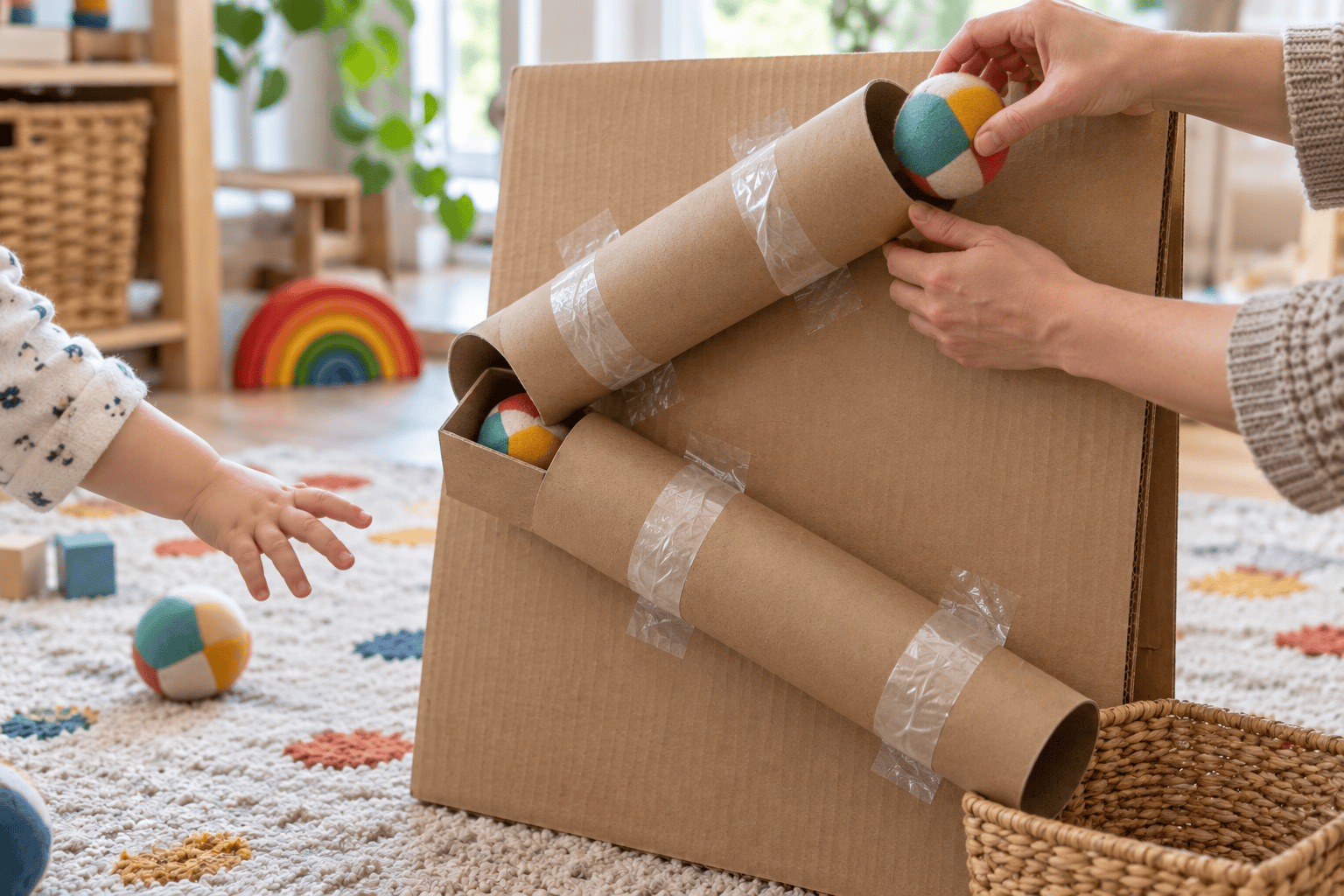
Two wide cardboard tubes, a handful of soft balls and a basket can turn the side of a box into a very busy little ball run. The best part? Your toddler gets to watch each ball disappear, reappear and demand another turn.

My favorite toddler activities have an obvious job. In this one, the job is “put the ball in the top.” Your child does not need a demonstration of every possible way to play. The ball vanishes for a second, rolls out somewhere else and somehow that remains fascinating long after the adult has understood the system.
This is a homemade ball run, not a polished toy-store marble maze. You can tape the tubes to a big shipping box and set it on the floor. If a ball misses the basket, your toddler probably considers retrieving it a bonus level.
The one detail worth getting right is size. Use a wide tube and a soft ball that rolls through easily but is too large to be a choking hazard for your child. Skip marbles, small pom-poms and loose little beads. A test ball that sticks halfway down a tube is a design flaw, not an invitation to poke a toddler finger after it.
Easy Cardboard Tube Ball Drop
A floor-level setup you can move out of the way when playtime ends.
Supplies and quantities
- 2 wide sturdy cardboard mailing tubes, about 3 inches across, with both ends open
- 1 large rigid piece of cardboard or the broad side of a shipping box
- 3–5 soft fabric balls that fit freely through the tubes and are appropriate for your child’s age
- Several strips of painter’s tape or strong packing tape for adult assembly
- 1 basket or shallow box to catch the balls
- Optional: blunt scissors for an adult to cut tube access openings if needed
If your balls are roughly 2 inches across, a tube around 3 inches wide gives them room to roll. Check each ball in the tube before you tape anything. A ball must be large enough to be age-appropriate and small enough to move freely through the chosen tube; if that combination is not possible with your supplies, use a wider tube.

Build a toddler ball drop step by step
- Stand up the backboard. Use the side of a sturdy box, or prop a large cardboard panel securely against a wall at floor level. Check that it cannot topple when a toddler touches it.
- Test the ball and tube. Drop each ball through a loose tube. It should come out without squeezing, shaking or poking. Remove any ball that jams.
- Angle the first tube. Hold it across the upper part of the board, with one end higher than the other. A gentle downhill angle is enough; you do not need a steep slide.
- Tape it firmly. Put tape around the outside near both ends, leaving the openings clear. Press the tape to the cardboard board, then tug lightly on the tube to check it stays put.
- Place the second tube lower down. Put its high opening below the first tube’s lower opening so a falling ball can enter it. Leave a short visible gap; seeing the ball pop out is half the fun.
- Secure the second tube. Tape outside both ends again. Put the basket under the final opening, and clear stray toys from the landing area.
- Run a test drop. Drop one ball yourself. Adjust either angle until it moves through both tubes and lands somewhere near the basket. “Near” is a perfectly acceptable engineering standard today.
- Invite your toddler in. Offer one ball and point to the top opening. Let them drop it, retrieve it and try again without crowding the entrance with all five balls.
What to do once the ball run works
Start by letting your toddler repeat the same drop. They may want to do it 30 times. You are under no obligation to add a new learning objective just because the setup looks simple. The small moment between the ball entering one tube and arriving at the basket is the entire appeal.
When they want a change, offer two colors of large balls and let them choose which goes first. You can move the basket farther away and see where the ball actually lands. Or put the basket right under the tube so the ball drops with a satisfying little thump.
If the balls bounce away, leave a clear patch of floor and call it the chase version. For a game that trades rolling for floating, try the foil boat sink-or-float activity. If your toddler begins carrying the balls directly to the basket instead of using the tubes, follow their plan for a while. The materials are doing their job if your child keeps playing. If they prefer scooping and pouring, our household-item sensory bins offer a different setup with familiar supplies.
Try holding a hand just below the exit so the ball rolls into your palm. Then trade roles: you feed the top while your toddler catches at the bottom. Keep your hands clear of the opening whenever a ball is coming through, and expect somebody to shout “Again!” at least once.
Fix a ball drop that keeps misbehaving
The ball stops in a tube
Check for a dent, exposed tape or a tube that is too narrow. Use a wider, smoother tube or a smaller age-appropriate soft ball; never rely on pushing a stuck ball through.
It rolls past the second opening
Move the second tube closer to the first exit. You can add a short cardboard flap as a guide, securely taped outside the ball’s route.
The tubes fall off
Press the tape firmly onto clean, dry cardboard. If it still peels away, use a sturdier backboard and add more tape around the outside of each tube.
The whole board tips
Stop and stabilize it before play resumes. Put the box flat against a wall or use a broad, heavy box on the floor rather than a tall loose panel.
The balls miss the basket
Move the basket, widen its opening or let the balls roll onto the floor. Catching every ball is optional.
The tape becomes a toy
Cover loose ends with another strip or retape the tube. Discard any peeled pieces rather than leaving sticky scraps within reach.
Three easy variations
One-tube starter
Use just one tube taped low to a box and catch balls in a basket. This is easier to line up for a younger toddler, and it lets you check whether your child enjoys the drop before building a second level.
Side-by-side race
For older preschoolers, tape two separate tubes at similar angles and let two large soft balls go at once. Do not promise an official winner; the tubes and balls will have their own opinions.
Color sorting finish
Place two baskets near the end and ask your child to carry a finished red ball to one and a blue ball to the other. Keep this optional. A toddler who only wants to drop balls has already found the point.

How to store or recycle it
Pull the basket and balls together into one box. The tube board can lean against a wall or slide behind a sofa if the tape and tubes are still secure. Check the joins again before each play session; cardboard bends and tape loosens, especially when the construction has been carried from room to room.
If the tubes have been crushed, recycling the cardboard and rebuilding later is easier than trying to straighten the path. Take off non-paper tape according to your local recycling rules. A new version does not need to look like the first one. Half the entertainment is seeing where the ball goes this time. If you need a seated activity next, the painter’s tape watercolor project uses the same satisfying reveal in a completely different way.
A quick safety note
Frequently asked questions
Can I use toilet paper rolls?
Only if you have a soft ball that safely fits and is appropriate for your child; most large toddler-safe balls will not fit. Wide mailing tubes are a more useful starting point for this version.
How do you make the ball go through both tubes?
Angle each tube gently downward and put the upper tube’s exit just above the lower one’s entrance. Test with one ball before inviting your toddler to play.
What kind of balls work best?
Choose large, soft, intact fabric balls that fit loosely through the wide tube and suit your child’s age. Avoid any ball small enough to be a choking hazard or one that sheds parts.
What if my toddler pulls the tubes off?
Reattach them while your child watches, or switch to a one-tube run at floor level. If the board cannot stay secure, put the activity away until you have a sturdier base.
Can a preschooler build this alone?
They can help choose the route and press down tape, but an adult should check stability and any cutting. Once it is built, let them direct where the basket goes.
Leave a Reply