
Red, blue, repeat—and stop while it is fun
AB Pattern Activities for Preschoolers: Build, Copy and Finish a Pattern

Start with four large pieces in an A-B-A-B repeat, read the line aloud, and offer two choices for the next spot. Build to eight pieces before trying one row of the Spring Patterns page.
AB patterns sound like something that requires tiny bears in six colors and a teacher voice. It can be much simpler: red lid, blue lid, red lid, blue lid. The letters are just a shorthand for “this thing, then that thing, and repeat.”
This tutorial uses two practical layers. First, you build a real pattern with large household objects. Then you use the Spring Patterns page from the Feral Toddler preschool workbook, which includes six picture rows with small number cues for four colors. The object version makes the repeating rule easy to see before crayons enter the picture.

Feral Toddler Etsy shop
Use the workbook’s Spring Patterns page
The printable preschool curriculum workbook includes the pattern page shown in this tutorial along with alphabet, handwriting, phonics, counting, math, science, seasonal, and creative pages.
Buy the preschool workbook on Etsy
What you need for an AB pattern activity
Build, Copy, and Finish an AB Pattern
A hands-on first round followed by one printable picture row.
Supplies
- 6 large red objects and 6 large blue objects of the same type
- 1 strip of plain paper, about 4 × 18 inches, or two sheets taped end to end
- Chunky black marker for two guide boxes
- 1 printed Spring Patterns workbook page
- Pink, yellow, violet, and light-blue crayons
- Low tray or table mat
Use plastic lids larger than a cardboard-tube opening, silicone cups, large blocks, or wide paper squares. Skip beads, pom-poms, buttons, dry pasta, and coins. If you cannot find matching household objects, cut six red and six blue cards about three inches square.
This post stays focused on one repeating unit. For a broader menu of counting, shapes, measuring, and number play, use the existing preschool math activities guide.
How to teach an AB pattern without making it fussy
- Prepare the pattern strip. Draw two large boxes at the left end and label them A and B for yourself. Your child does not need to memorize the letters.
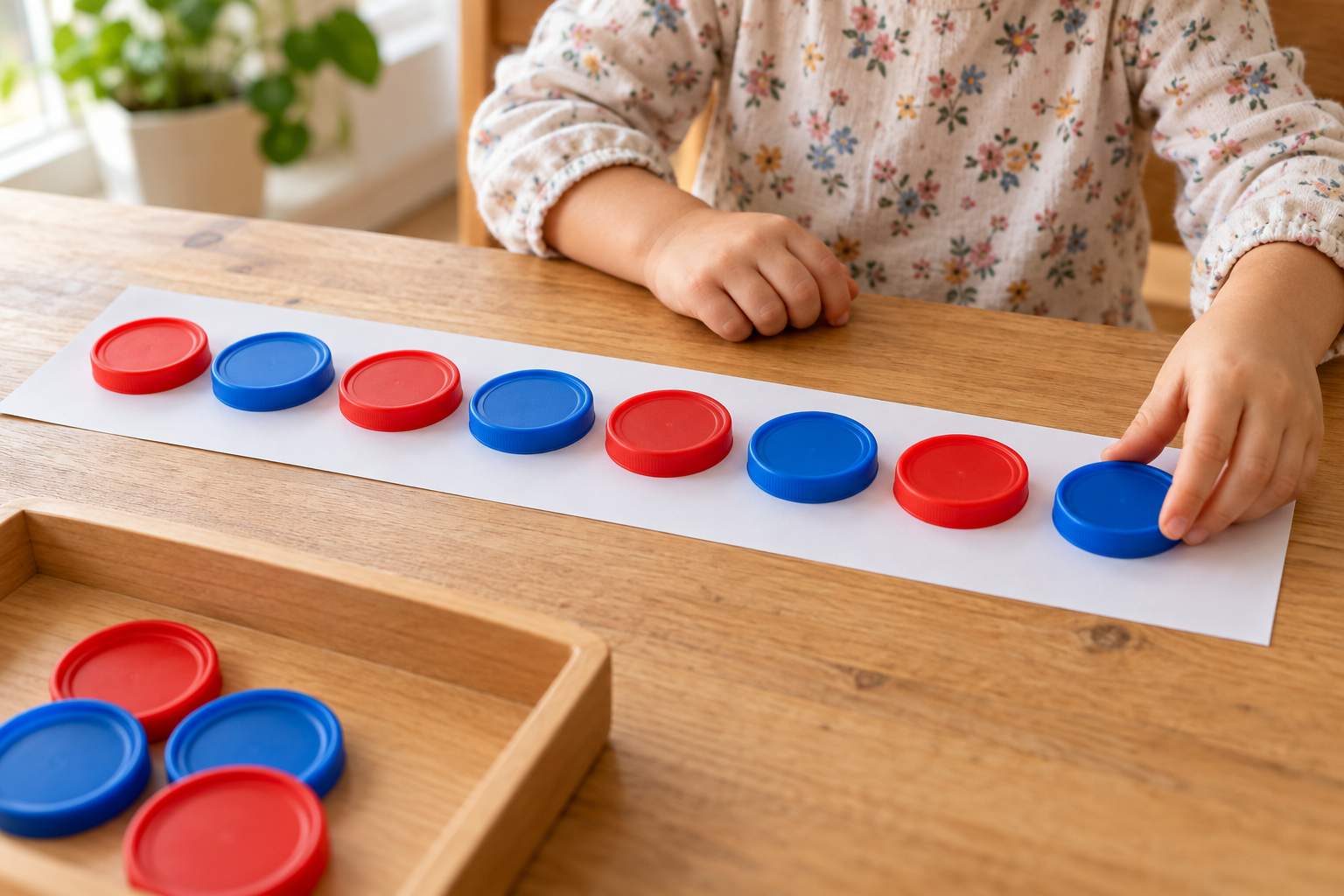
- Choose two colors. Place one red lid in the A box and one blue lid in the B box. Say “red, blue.”
- Repeat the pair once. Add a red lid and a blue lid directly after the guide boxes. Slide the four pieces close enough that they read as one line.
- Point through the pattern. Touch each piece and say “red, blue, red, blue.” Keep the pace even; no dramatic pause before the answer.
- Offer two choices for the next spot. Hold up one red and one blue lid and ask, “What comes next?” If your child guesses, place it and read the whole line again.
- Build to eight pieces. Continue until you have four red-blue units. Stop there for the first round rather than filling the whole table.
- Copy the pattern beside it. Start a second red-blue line and let your child use the completed one as a model. Copying and finishing are different tasks, and both are useful ways to play.
- Open the Spring Patterns page. Point to the key at the top: 1 pink, 2 yellow, 3 violet, 4 light blue. Choose one simple row rather than completing all six.
- Color from left to right. Read each small number, choose the matching crayon, and color the picture. The final boxed picture is part of the same row.
- Check by reading the colors aloud. If the row says pink, yellow, pink, yellow, point through it the same way you read the lid pattern.
If the crayon key feels like an extra layer, stay with objects today. You can use the companion color-sorting setup first so the four crayon colors are familiar before asking your child to follow numbered color cues.
Copying, extending, and finding the missing piece
These are three separate versions of the activity. You do not need to do all three at once.
- Copy: Build red-blue-red-blue and make the same line underneath.
- Extend: Build four pieces and add the next two.
- Find the missing piece: Build red-blue-red-blank-red-blue and choose what belongs in the blank.
Start with copying if your child wants to imitate you. Use extending when they can comfortably point through the repeat. Save a missing-piece puzzle for another day; an empty gap in the middle is more abstract than adding to the end.

Troubleshooting pattern activities
Every piece becomes the same color
Return to the two guide boxes. Hand over one red and one blue piece at a time instead of leaving a pile within reach.
The line wanders all over the table
Use a long paper strip or a ruler as the lower edge. A clear path matters more than perfectly straight spacing.
Your child guesses randomly
Point through the full line aloud, then offer the two possible next pieces. The choice becomes visible instead of mysterious.
The workbook key is confusing
Put each crayon directly under its number in the key. Work one picture at a time and cover the rows below.
Coloring takes over
Color only one row, or let an adult fill the large areas while your child chooses the correct crayon. The goal today is following the repeat.
The objects keep rolling
Use flat paper squares, silicone cups placed upside down, or blocks on a rimmed tray. Round jar lids are easier when laid flat.
Three ways to vary an AB pattern
Shape pattern
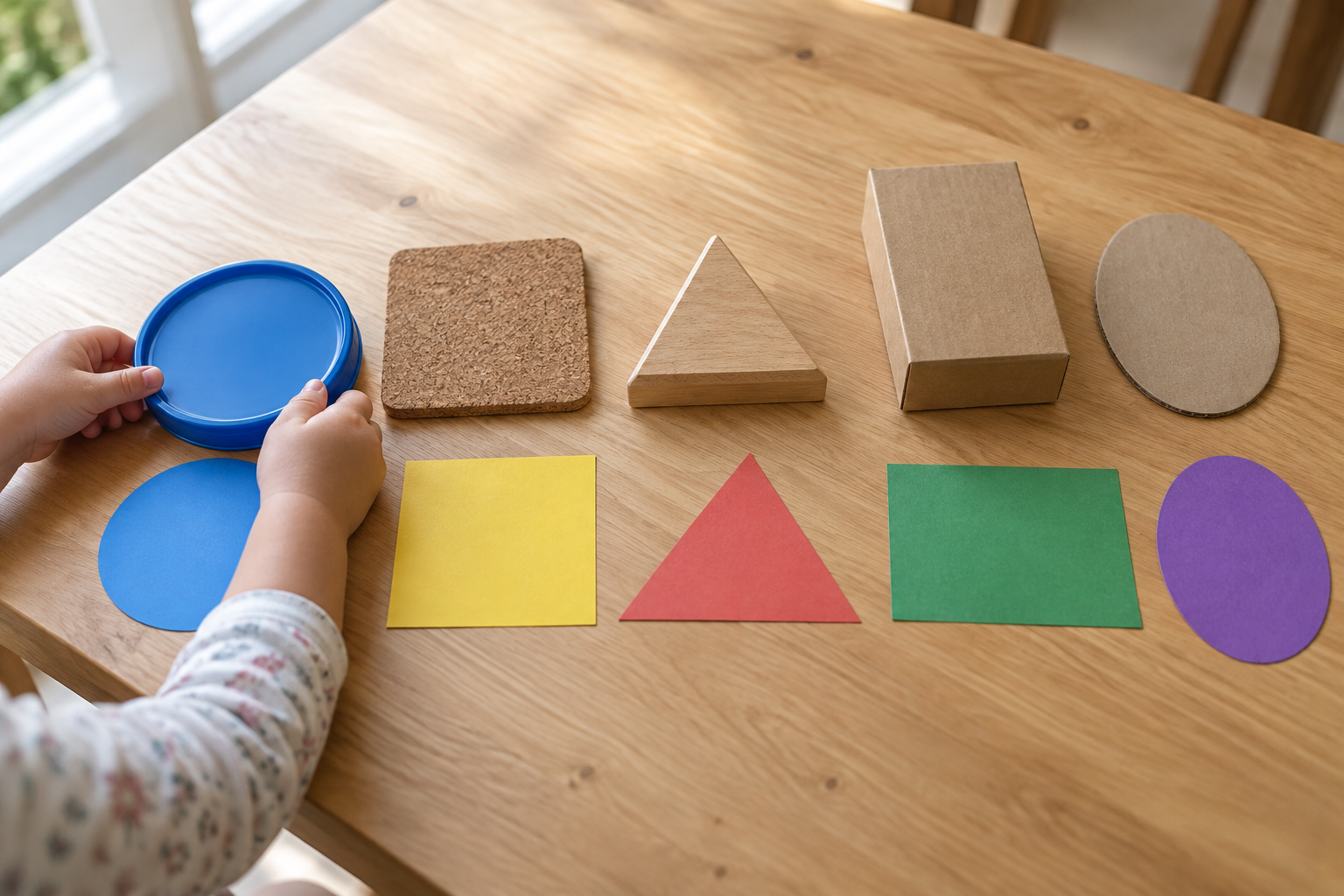
Alternate large paper circles and squares. If the outlines are still new, use the sibling shape-matching game first, then bring the same two paper shapes into the pattern line.
Movement pattern
Make a clap-stomp-clap-stomp repeat with an adult modeling beside the child. Keep it to two actions and four or six total beats.
Snack-time pattern
Alternate two age-appropriate snack pieces on a plate, such as cracker-cheese-cracker-cheese. Use foods your child already eats safely, and let the pattern disappear in the obvious way.
Keep the pattern kit very small
Store twelve large pieces and the folded paper strip in one labeled box. You do not need a different kit for every color. Swap the two colors, use paper shapes, or borrow two sets of blocks from the toy shelf.
Slide the Spring Patterns page into a folder with the rest of the workbook pages. The preschool workbook guide has more practical advice for deciding how many pages to offer and when to stop.

AB pattern FAQs
What does AB pattern mean?
It means two different elements repeat in the same order: A, B, A, B. The elements can be colors, shapes, objects, sounds, or movements.
How many pieces should I start with?
Use four pieces to show the repeat, then offer the fifth and sixth. Eight total pieces make a complete first activity.
Should I say A and B to my preschooler?
You can, but the concrete words are usually clearer: “red, blue, red, blue.” The letters are simply a label for the repeating positions.
What comes after an AB pattern?
When AB feels easy, you can try AAB, ABB, or ABC patterns. Change only one thing at a time and keep the pieces large and familiar.
Do we have to finish the whole printable?
No. One picture row is enough for one sitting. Fold or cover the remaining rows and return later if your child wants another round.



Leave a Reply